
When a recommendation fails in an AI catalog, the most common instinct is to inspect the final answer and conclude that “the model got it wrong.”
That is usually the wrong starting point.
The visible error is often the last link in a longer chain. The correct product may have disappeared much earlier. Or the wrong product may have survived a stage where it should already have been removed. If you do not locate that first leak, you end up changing prompts, embeddings, or rules blindly.
In summary
To debug a wrong recommendation, walk the pipeline in order and locate the first faulty stage: interpretation → market → retrieval → filters → ranking → selection → text → cards. Pinecone distinguishes multiple search modes with different signals; BM25 remains a foundational lexical ranking model; dense retrieval and BERT reranking operate as separate stages; and recent RAG evaluation frameworks explicitly separate retrieval and generation to diagnose where the error actually begins.
Do not start with the final answer
The final answer is useful for noticing that something is wrong. It is not always useful for understanding why.
If the system recommends the wrong product, several different things might have happened:
- it misread the intent;
- it queried the wrong market;
- it failed to retrieve the correct product;
- it retrieved too much noise;
- it filtered badly;
- it ranked badly;
- it selected badly among valid items;
- it wrote misleading text;
- or it rendered cards that do not match the decision.
RAGVUE explicitly separates retrieval quality, answer completeness, and faithfulness to evidence. Recent error-taxonomy work makes the same point from another angle: early errors in retrieval or reranking often show up later as apparently bad generation.
Debugging pipeline
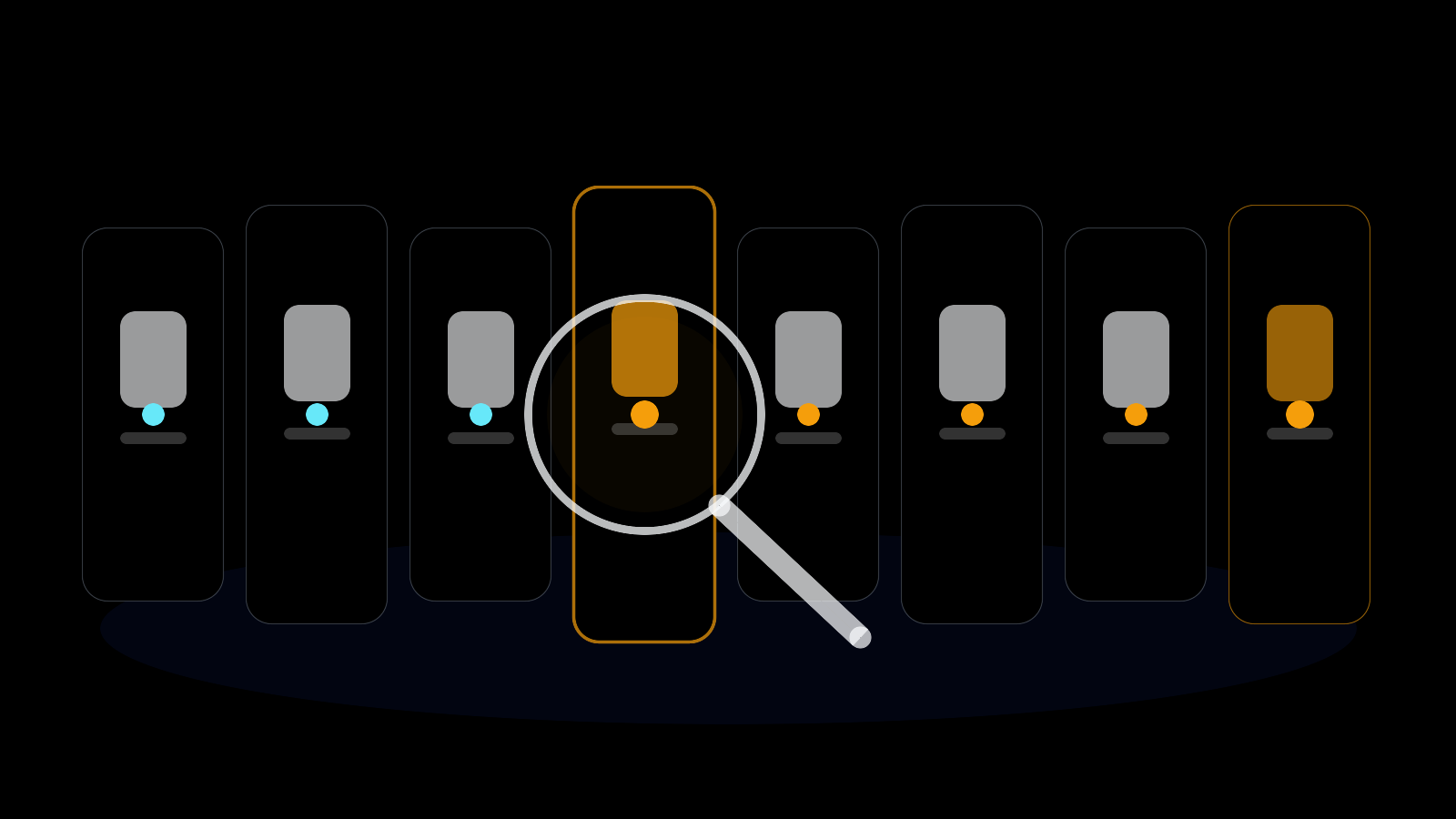
The right question is not “what did the system say wrong?” It is this:
At which exact stage did the correct product stop being available, or at which stage did the wrong one survive?
Interpretation failures
Interpretation fails when the query is already translated into the wrong structured intent.
Typical symptoms:
- an implied need becomes the wrong product family;
- an exact reference is treated like natural language;
- a mandatory requirement is downgraded into a preference;
- or an ambiguous request is answered without asking for clarification.
At that point, the problem is not retrieval yet. It is classification and intent contract. Pinecone’s own search guidance recommends exact or token-based retrieval when queries share specific tokens with the data — product names, identifiers, technical jargon — and dense semantic retrieval when the dominant signal is natural-language meaning. If the system classifies the query type incorrectly, the rest of the pipeline inherits that mistake.
Market failures
Sometimes a recommendation looks relevant, but it belongs to the wrong market.
Typical symptoms:
- a URL from the wrong country;
- prices that do not match the active catalog;
- the right language but the wrong market data;
- mixed availability across catalogs.
That usually points to a namespace, agent-selection, or metadata-filter problem. Pinecone documents namespaces as the unit that queries target, and metadata filters as the mechanism that limits results to matching records.
Retrieval failures
Retrieval fails when the correct product should be among the candidates but never appears.
Here it helps to distinguish:
- exact matching;
- sparse lexical retrieval;
- dense semantic retrieval;
- hybrid retrieval.
BM25 remains a strong baseline when exact tokens matter, and Pinecone still recommends full-text or lexical search for product names, identifiers, and precise phrases. Dense retrieval, meanwhile, is useful when conceptual similarity matters more than exact wording. So a retrieval failure does not automatically mean “better embeddings.” Sometimes it means a different search mode or a different signal mix.
Filter failures
If the correct product appears among candidates but vanishes later, filters are the first suspect.
Filters fail when they remove something that should remain or keep something that should die.
Examples:
- the correct product is removed because a metadata field is missing or mistyped;
- availability is stale;
- compatibility is treated as false by default;
- or a channel rule is applied before context is normalized.
Pinecone documents metadata filtering as an explicit way to narrow results to matching records. That is powerful, but it also means a badly modeled field can kill the correct product very early.
Ranking failures
Ranking fails when the right product is still alive, but too low.
That happens when the correct signal exists but is underweighted, or when a business preference rescues a mediocre product too aggressively.
It helps to remember the familiar two-stage architecture: efficient first-stage retrieval followed by a more expensive reranker. The BERT reranking literature starts precisely there: retrieve a candidate set with a scalable method such as BM25, then reorder those candidates with a more intensive reranker. If the right product enters but never rises, the issue is no longer recall. It is weighting, features, or reranking.

Selection failures
Sometimes several valid products survive and the system chooses the wrong final subset.
That is not purely a ranking problem and not yet a generation problem. It is a selection-policy problem:
- showing storage when the user never asked for storage;
- choosing the best-documented item instead of the best-fit item;
- favoring business preference against explicit intent;
- or returning too many redundant variants.
At this stage, you need more than the final score. You need inclusion and exclusion reasons.
Text failures
A subtler case happens when the product selection is correct, but the explanatory text is wrong.
Typical symptoms:
- the text attributes properties not present in the facts;
- it claims compatibility that was never proven;
- it overstates availability;
- or it summarizes the backend result inaccurately.
ARES and RAGVUE are useful mental models here because they keep retrieved relevance, completeness, and faithfulness separate. A good selection can still lose credibility if the text layer improvises.
Card failures
The final stage can also break trust even if selection and text are correct.
Examples:
- card from the wrong ID;
- mismatched image;
- missing URL;
- stale price;
- attributes inconsistent with the explanation.
When that happens, the issue is no longer the model. It is the contract between backend and rendering.
What I would log
If I had to instrument the pipeline minimally, I would keep one trace per query with:
- the original query;
- the structured intent;
- market and namespace;
- lexical candidates;
- semantic candidates;
- merged candidates;
- filter exclusions with reasons;
- ranking signals;
- final selection;
- generated text;
- final rendered card payload.
The reason is practical: you cannot locate the first faulty stage if you only preserve the last answer.

The core idea
Debugging an AI catalog is not about debating whether the model “understood” or “didn’t understand.”
It is about locating the earliest stage where the architecture lost control. Once that point is clear, the work stops feeling magical and becomes engineering again.
Related reading
- Vector Search in Sales Catalogs: Why Semantics Alone Isn’t Enough
- How to Prepare the Knowledge Base for a Sales AI Agent
- Business Rules in Sales AI Agents: When to Ask, Filter, or Escalate
- Why a Prompt Is Not a Sales Automation Strategy
Frequently Asked Questions
- Does a wrong recommendation always mean an embeddings problem?
- No. The failure may happen earlier in interpretation or market selection, or later in filters, ranking, selection, text, or cards.
- How do I know whether the problem is retrieval or ranking?
- If the correct product never enters the candidate set, retrieval failed. If it enters but stays too low, ranking or reranking failed.
- Why log namespace and metadata?
- Because a market leak or a bad filter can eliminate the correct product before ranking even begins.
- Can generated text fail even if selection is good?
- Yes. The explanation can overinterpret facts or claim properties that the backend never returned.